
Iowa Spine and Performance
Why Active Adults Can't Seem to Fix Their Knee Pain
Even after PT and chiropractic — the real reason it keeps coming back, and what most providers never actually assess.
Or call 515-303-4176
By Dr. Michael Henrichs · Iowa Spine and Performance · Des Moines, IA
THE GUIDE
Five Reasons Your Knee Pain Keeps Coming Back
Not a list of home exercises — the real reasons active adults stay stuck, and what a proper root cause assessment actually looks like.
01
Your Knee Isn’t Actually the Problem
The knee is where you feel it. It’s rarely where it starts. When your knee hurts, the natural instinct is to treat the knee — ice it, mobilize it, strengthen it. For a while, that might take the edge off. But if the pain keeps coming back, it’s because the root cause was never addressed.
In a large percentage of chronic knee pain cases, the real problem is hip stability — or the lack of it. When the glutes and deep hip stabilizers aren’t doing their job, the knee is forced to compensate. Every step, every squat, every landing, every change of direction — the knee absorbs load it was never designed to handle alone.
A proper assessment doesn’t start at the knee. It starts above it — looking at how the hip controls movement under load. That single shift in approach changes everything about how the problem gets solved.
Treating the knee directly rarely sticks. You’re managing the complaint, not solving the cause.
Not Producing Enough Force — Or Not Absorbing It Properly
One of the most overlooked distinctions in knee pain is this: the pain you feel during a squat, sprint, or jump might come from two entirely different mechanical failures — and treating the wrong one is why so many people stay stuck.
Force production is your body's ability to generate power — pushing off the ground, driving through a squat, accelerating out of a cut. When this breaks down, you feel it as weakness and sluggishness.
Force absorption is the opposite — your ability to decelerate, stabilize, and control impact. Landing from a jump, slowing from a sprint, absorbing a downhill run. When this breaks down, the pain shows up under load. A knee that feels like it can't be trusted when things get dynamic.
Same joint. Same complaint. Completely different root cause — and treating one when you have the other will get you nowhere.
02
03
Is It A Knee Injury — Or a Capacity Problem?
One of the biggest fears active adults carry with chronic knee pain is that something is seriously wrong — torn, degenerating, headed toward surgery. Sometimes that fear is valid. But in many cases, what feels like a serious structural problem is actually a capacity issue. The knee isn't damaged. It's overwhelmed.
A capacity issue means the knee isn't injured — it simply doesn't have the strength, endurance, or control to handle the demands being placed on it. The pain shows up as dull or achy discomfort during or after activity, flaring with certain movements and quieting with rest.
Whether it's a capacity issue or something structural, the answer is the same — you need a root cause assessment to know which one you're dealing with. Both are treatable. Both need the right approach. The worst thing you can do is guess.
You can't tell the difference on your own. Assuming which one you have is how people end up resting when they should be loading — or loading when they should be protecting the joint.
Stopping the Activity Is Making It Worse
The most common advice active adults get when knee pain shows up is: stop, rest, take it easy, let it calm down. On the surface that makes sense. It hurts when you move, so stop moving.
But rest alone almost never solves chronic knee pain. It quiets the noise — but it doesn't fix what's creating it. The moment you return to activity, the same problem is still there waiting.
Tendons, cartilage, and the tissues around the knee need progressive load to adapt, strengthen, and become resilient. When you remove that stimulus completely, those tissues don't recover — they decondition. This is why so many active adults fall into the same cycle: pain flares, they rest, it calms down, they return, it flares again.
The activities you love aren't the enemy — they're part of the solution. But only when the loading is right and the root cause has been identified.
04
05
What Most Providers Miss in the First Visit
If you've been through PT or chiropractic for knee pain, you probably know how the visit goes. You describe where it hurts. They do some manual work on the knee. You're given a set of exercises — quad sets, terminal knee extensions, some stretching. You're told to rest, reduce activity, and come back in a week.
For some people, that's enough. For active adults with chronic, recurring knee pain, it almost never is — because that approach treats the location of the pain, not the cause of it.
A proper assessment looks completely different. It starts by watching how you move — how your hip controls your knee during a squat, a single leg stance, a landing. It tests whether the breakdown is force production or force absorption. It identifies where the knee starts compensating. That's not a 10-minute intake. It's a thorough root cause assessment.
You haven't failed at fixing your knee pain. Nobody's addressed the root cause yet. That's the gap — and closing it starts with one visit done the right way.
WHO WE ARE
The Doctors Behind This Guide
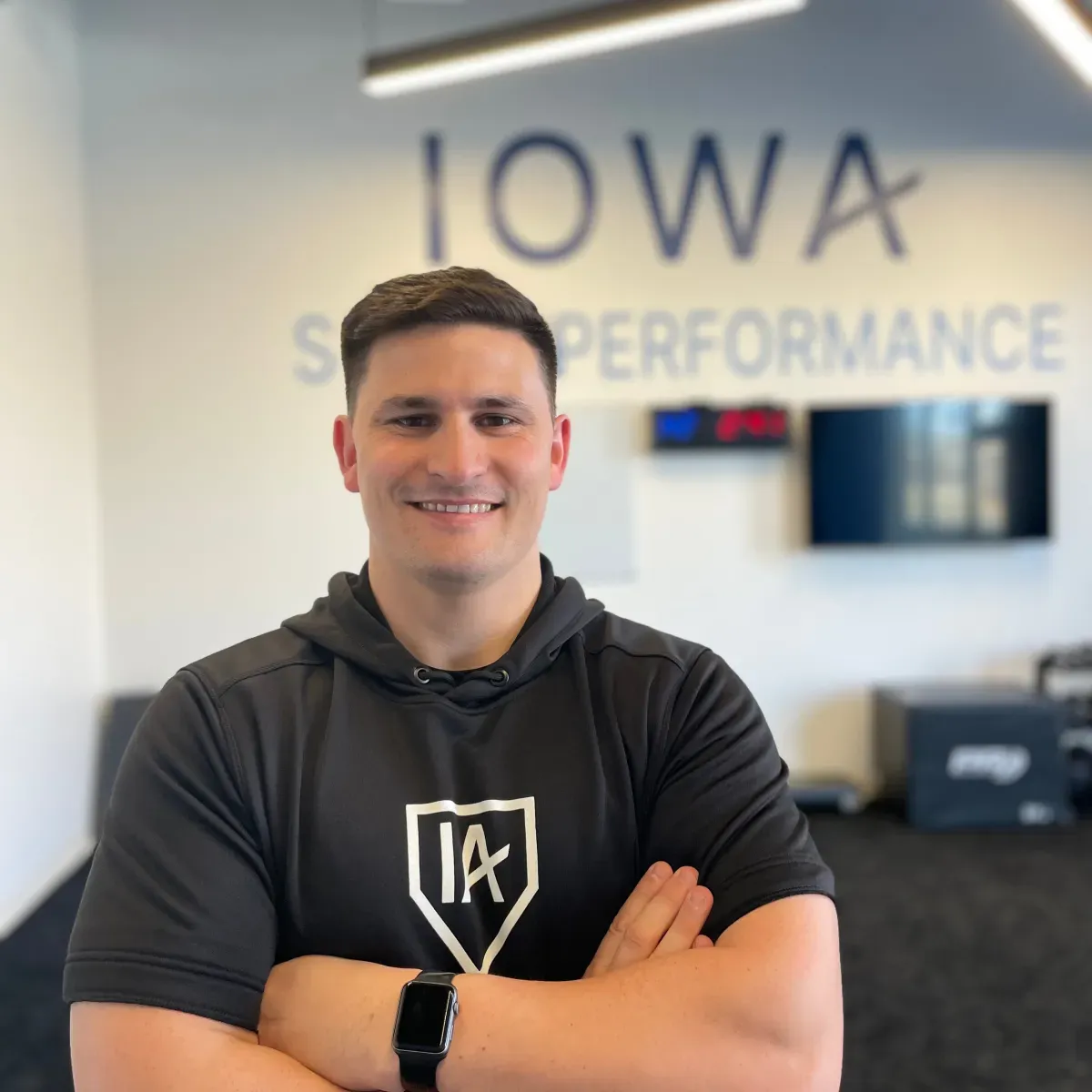
Dr. Michael Henrichs
Owner / Lead Clinician
Dr. Mike was born in Des Moines and is a Carlisle High School graduate. He earned his pre-med degree from Upper Iowa University, where he was a four-year starter and captain for the Peacocks baseball team. He received his doctorate of chiropractic and rehab certifications from Cleveland University in Kansas City, where he had the privilege of treating military veterans at the Kansas City VA Medical Center alongside MDs, DOs, DPTs, and orthopedic surgeons. His experience as a collegiate athlete has given him the opportunity to treat many professional athletes and help return them to sport following injury. When not serving Central Iowa, Dr. Mike loves traveling with his wife Aimee, daughter Olivia, and son Tres — and is an avid outdoorsman, archer, and hunter.

Dr. Cameron Whitehead
Clinician
Dr. Cam was born in Omaha, NE and is a Sidney, IA native. He received his Bachelor of Arts in Health and Exercise Science from Simpson College in Indianola, IA. He then attended Palmer College of Chiropractic in Davenport, IA, graduating Valedictorian and earning a Clinical Excellence Award nomination. While in school, he interned in the Palmer rehab department and was active in the Motion Palpation Institute and Rehab 2 Performance clubs. Today, Dr. Cam lives in Norwalk with his wife Taylor and their two dogs, Rosie and Frankie. Outside the clinic, he enjoys time with family and friends and is proud to serve Central Iowa with evidence-based, patient-centered care.
Together, we built Iowa Spine and Performance for one type of person: the active adult who refuses to accept that pain is just part of getting older — and who wants real answers, not managed symptoms.
QUICK LINKS
HEALTH ADVICE DISCLAIMER
The information in this guide is for educational purposes only and does not constitute a diagnosis or treatment plan. A 100% accurate diagnosis can only be made following a comprehensive physical examination by a licensed clinician. The guidance provided does not replace a hands-on evaluation at Iowa Spine and Performance. Attempting to manage an injury without professional advice carries the risk of further harm. No specific results are guaranteed or implied.
© 2026 Iowa Spine and Performance. All rights reserved.